
Selected Topics
Musical Definitions
Music is essentially, and mostly, a series of one or more audio tones (frequency = 'pitch') of a defined duration, interspersed with silence ('rests'). Since nothing is ever completely as simple as it seems, here are some, more distinct (not the right word I am looking for, but close), definitions of musical concepts such as 'Pitch'. These mostly come from wikipedia, however, given that the contributors to wikipedia are even more anal about these things than I am, I will generally give the reader's digest version, along with links to the original so that the completeness may be explored at leisure.
Pitch
http://en.wikipedia.org/wiki/Pitch_(music))Pitch represents the perceived fundamental frequency of a sound. It is one of the major auditory attributes of musical tones along with duration, loudness, timbre, and sound source location.
Pitch allows the construction of melodies; pitches are compared as "higher" and "lower", and are quantified as frequencies (cycles per second, or hertz), corresponding very nearly to the repetition rate of sound waves. However, pitch is not an objective physical property, but a subjective psychophysical attribute of sound.
Perception of pitch
Pitch is a subjective sensation in which a listener assigns perceived tones to relative positions on a musical scale based primarily on the frequency of vibration. The total number of perceptible pitch steps in the range of human hearing is about 1,400; the total number of notes in the equal-tempered scale is 120.
Pitch is related to frequency, but they are not equivalent. Frequency is the scientific measure of pitch. While frequency is objective, pitch is completely subjective.
Pitch depends to lesser degree on the sound pressure level (loudness, volume) of the tone, especially at frequencies below 1,000 Hz and above 2,000 Hz. The pitch of lower tones gets lower as sound pressure increases. For instance, a tone of 200 Hz that is very loud will seem to be one semitone lower in pitch than if it is just barely audible. The pitch of higher tones gets higher as the sound gets louder.
Concert pitch
http://en.wikipedia.org/wiki/Concert_pitchConcert pitch is the pitch reference to which a group of musical instruments are tuned for a performance. Concert pitch may vary from ensemble to ensemble, and has varied widely over musical history.
The A above middle C is usually set at 440 Hz (often written as "A = 440 Hz" or sometimes "A440"), although other frequencies are also often used, such as 442 Hz. Historically, this A has been tuned to a variety of higher and lower pitches. For example, Michael Praetorius proposed a standard of 465 Hz in the early 17th century.
The transposing instruments in an orchestra will conventionally have their parts transposed into different keys from the other instruments (and even from each other). As a result, musicians need a way to refer to a particular pitch in an unambiguous manner when talking to different sections of the orchestra. For example, the most common type of clarinet or trumpet, when playing a note written in their part as C, will sound a pitch that would be called Bb on a non-transposing instrument like a piano. If you wanted to refer to that pitch unambiguously, you would call it "concert Bb", meaning "the pitch that someone playing a non-transposing instrument like a piano would call Bb".
Helmholtz pitch notation
http://en.wikipedia.org/wiki/Helmholtz_pitch_notationHelmholtz pitch notation is a musical system for naming notes of the Western chromatic scale. Developed by the German scientist Hermann von Helmholtz, it uses a combination of upper and lower case letters (A to G), and the sub- and super-prime symbols (,') to describe each individual note of the scale. It is one of two formal systems for naming notes in a particular octave, the other being scientific pitch notation.
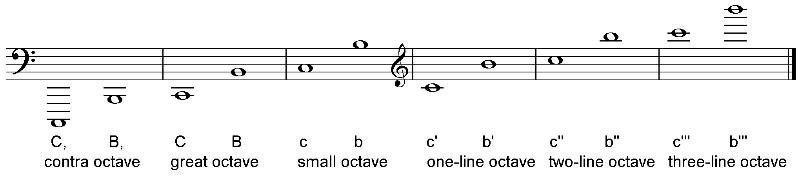
Helmholtz developed this system in order to accurately define pitches in his classical work on acoustics 'Die Lehre von den Tonempfindungen als physiologische Grundlage für die Theorie der Musik' (1863) - translated into English by A. J. Ellis as 'On the Sensations of Tone' (1875). The system is now used widely by musicians across Europe, and by scientists and doctors when discussing the scientific and medical aspects of sound in relation to the auditory system. Usage: The Helmholtz scale always starts on the note C and ends at B (C, D, E, F, G, A, B). The note C is shown in different octaves by using upper-case letters for low notes, and lower-case letters for high notes, and adding sub-primes and primes in the following sequence: C,, C, C c c' c'' c''' (or ,,C ,C C c c' c'' c''') and so on.
Middle C is designated c', therefore the octave upwards from middle C is c' - b'.
Each octave may also given a name based on the "German method" (see below). For example, the octave from c'-b' is called the one-line octave.
While this method looks very similar to the ABC notation of music, currently used mainly in the notation of folk music, differences do exist.
Staff representation This diagram gives examples of the lowest and highest note in each octave, giving their name in the Helmholtz system, and the "German method" of octave nomenclature. (The octave below the contra octave is known as the sub-contra octave).
Rhythm
http://en.wikipedia.org/wiki/RhythmRhythm is the arrangement of sounds and silences in time. Meter animates time in regular pulse groupings, called measures or bars. The time signature or meter signature specifies how many beats are in a measure, and which value of written note is counted and felt as a single beat. Through increased stress and attack (and subtle variations in duration), particular tones may be accented. There are conventions in most musical traditions for a regular and hierarchical accentuation of beats to reinforce the meter. Syncopated rhythms are rhythms that accent unexpected parts of the beat. Playing simultaneous rhythms in more than one time signature is called polymeter.
Melody
http://en.wikipedia.org/wiki/MelodyA melody is a series of notes sounding in succession. The notes of a melody are typically created with respect to pitch systems such as scales or modes. The rhythm of a melody is often based on the inflections of language, the physical rhythms of dance, or simply periodic pulsation. Melody is typically divided into phrases within a larger overarching structure. The elements of a melody are pitch, duration, dynamics, and timbre.
In the context of theory, a piece of music may be melodically based. In this instance, a composer will first take a melody, and use that to create his or her work. A harmonically based piece, on the contrary, will focus on a chord progression, with the melody as a secondary or incidental factor of composition.
Harmony
http://en.wikipedia.org/wiki/HarmonyHarmony is the study of vertical sonorities in music. Vertical sonority refers to considering the relationships between pitches that occur together; usually this means at the same time, although harmony can also be implied by a melody that outlines a harmonic structure.
The relationship between two pitches is referred to as an interval. A larger structure involving more than two pitches is called a chord. In common practice and popular music, harmonies are generally tertian. This means that the interval of which the chords are composed is a third. Therefore, a root-position triad (with the root note in the lowest voice) consists of the root note, a note a third above, and a note a third above that (a fifth above the root). Seventh chords add a third above the top note of a triad (a seventh above the root). There are some notable exceptions. In 20th century classical music, many alternative types of harmonic structure were explored. One way to analyze harmony in common practice music is through a Roman numeral system; in popular music and jazz a system of chord symbols is used; and in post-tonal music, a variety of approaches are used, most frequently set theory.
The perception of pitch within harmony depends on a number of factors including the interaction of frequencies within the harmony and the roughness produced by the fast beating of nearby partials. Pitch perception is also affected by familiarity of the listener with the music, and cultural associations.
Scales and Modes
http://en.wikipedia.org/wiki/Musical_scalehttp://en.wikipedia.org/wiki/Musical_mode
Notes can be arranged into different scales and modes. Western music theory generally divides the octave into a series of 12 notes that might be included in a piece of music. This series of twelve notes is called a chromatic scale. In the chromatic scale, each note is called a half-step or semitone. Patterns of half and whole steps (2 half steps, or a tone) can make up a scale in that octave. The scales most commonly encountered are the seven toned major, the harmonic minor, the melodic minor, and the natural minor. Other examples of scales are the octatonic scale, and the pentatonic or five-toned scale, which is common in but not limited to folk musics. There are scales that do not follow the chromatic 12-note pattern, for example in classical Persian, Indian and Arabic music. Arabic and Persian classical traditions often make use of quarter-tones, half the size of a semitone, as the name suggests. Contrary to popular belief, however, this is not true of Indian music, which uses seven notes and five variant notes that correspond to the twelve tones of the European chromatic scale, but are used very differently. Theoretically the twelve tones of Indian music map onto a 22 division of the octave according to the thirteenth-century Sanskrit treatise, the Sangita Ratnakara.
In music written using the system of major-minor tonality, the key of a piece determines the scale used. (One way of showing how various keys relate to one another may be seen in the circle of fifths.) Transposing a piece from C major to D major will make all the notes two semitones (or one full step) higher. Even in modern equal temperament, changing the key can change the feel of a piece of music, because it changes the relationship of the composition's pitches to the pitch range of the instruments that play the piece. This often affects the music's timbre, as well as having technical implications for the performers. However, performing a piece in one key rather than another may go unrecognized by the casual listener, since changing the key does not change the relationship of the individual pitches to each other. A key change, or modulation, may occur during a piece, which is more easily heard as a difference of intervals in sound.
Allocation
Allocation, or Allocation of Voice refers to the function and number of voices in any given example of music. A voice is any single melodic line. The term includes the number of voices: Solo (one voice), Duet (two voices), Trio (three voices), Quartet (Four voices), Quintet (five voices), sextet (six voices) and so on. The term also includes the function of voices: Solo (one voice), Group (two or more voices), Solo+Group, (two or more voices featuring a soloist), Group+Group or Dialogue (exchange between groups), and Call and Response (any of the former in alternating exchange with another of the former).
Timbre
Timbre, sometimes called "Color", or "Tone Color" is the quality or sound of a voice or instrument. The quality of timbre varies widely from instrument to instrument, or from voice to voice. The timbre of some instruments can be changed by applying certain techniques while playing. For example, the timbre of a trumpet changes when a mute is inserted into the bell, or a voice can change its timbre by the way a performer manipulates the vocal apparatus, (e.g. the vocal chords, mouth and diaphragm). Generally, there is no common musical notation that speaks specifically to a change in timbre, (as "pianissimo" would indicate "very soft" for a change in dynamics).
Expressive Qualities
Expressive Qualities are those elements in music that create change in music that are not related to pitch, rhythm or timbre. They include Dynamics and Articulation.
Dynamics
http://en.wikipedia.org/wiki/Dynamics_%28music%29In music, the term "dynamics" normally refers to the softness or loudness of a sound or note: e.g. pianissimo or fortissimo. Until recently, most dynamics in written form were done so in Italian, but recently are sometimes written or translated into English. Another sense of the word refers to any aspect of the execution of events in a given piece; either stylistic (staccato, legato etc.) or functional (velocity) are also known as dynamics. The term is also applied to the written or printed musical notation used to indicate dynamics.
Articulation
Articulation is the manner in which the performer applies their technique to execute the sounds or notes—for example, staccato or legato. Articulation is often described rather than quantified, therefore there is room to interpret how to execute precisely each articulation. For example, Staccato is often referred to as "short" or "detached" rather than having a defined, or numbered amount by which the shortness or detachment is to take place. Often the manner in which a performer decides to execute a given articulation is done so by the context of the piece or phrase. Also, the type or style of articulation will depend on the instrument, but there is a generally recognized set of articulations that most all instruments, (and voices) have in common. They are, in order of long to short: legato ("smooth, connected"); tenuto ("pressed", "lengthened but detached"); marcato (heavily accented and detached); staccato ("short", "detached"). Any of these may be combined to create certain "in-between" articulations. For example, portato is the combination of tenuto and staccato. Some instruments have unique methods by which to produce sounds such spicatto for strings, where the bow bounces off the string.
Notation
http://en.wikipedia.org/wiki/Musical_notation(Or, more preferably;) http://en.wikipedia.org/wiki/Modern_musical_symbols
Musical notation is the symbolic representation of music (not to be confused with audio recording). Historically, and in the narrow sense, this is achieved with graphic symbols. Computer file formats have become important as well. Spoken language and hand signs are also used to symbolically represent music, primarily in teaching.
In standard Western music notation, music is represented graphically by notes placed on a staff or staves with the vertical axis roughly corresponding to pitch and the horizontal axis roughly corresponding to time. Note head shapes, stems, flags, and ties are used to indicate duration. Additional symbols represent key, tempo, dynamics, accents, rests, etc.